
Why Dorchester crawl spaces stay damp
You notice the smell first, usually in a closet or under the kitchen sink, a damp, earthy odor that comes back no matter how often you open the windows. In Dorchester, that smell almost always starts under the floor. Homes here sit on low ground near the tidal creeks and marsh of Liberty County, and the soil is mostly loose sand over a high water table. Moisture rises from that ground all year.
Then there's the air. Coastal Georgia summers push warm, salty, humid air through every foundation vent. When that air meets the cooler underside of your floor, ducts and pipes, it condenses. Wood soaks it up. You end up with sweating ductwork, fuzzy white or black growth on joists, and insulation batts sagging out of the floor system like wet laundry.
The old advice was to vent the crawl space so it could "breathe." Along the Georgia coast, from Dorchester down to Brunswick and St. Simons Island, venting mostly lets more humid air in. That's why so many local homes with open vents still have damp crawl spaces.
What crawl space encapsulation involves
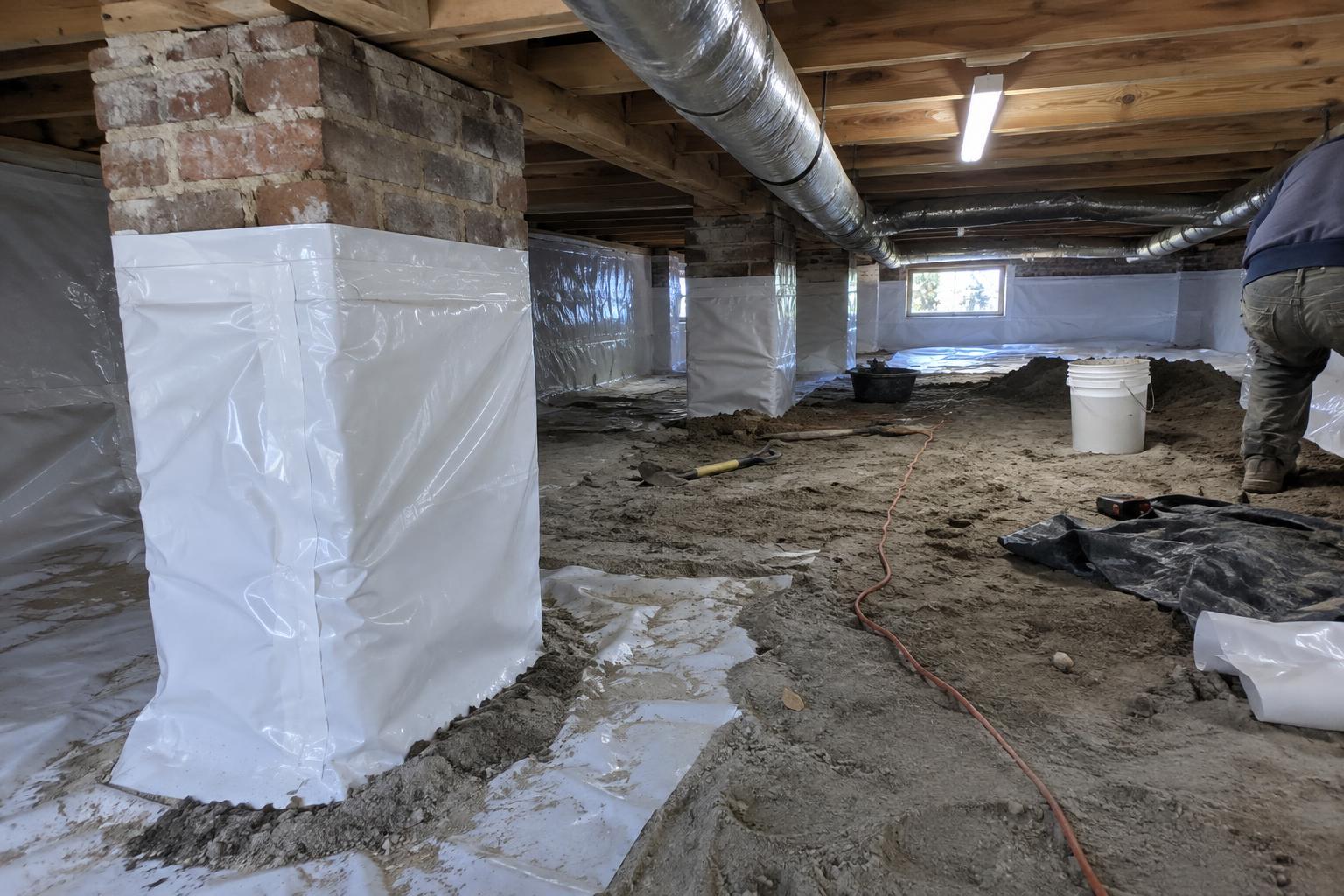
Crawl space encapsulation closes the crawl space off from the ground and the outside air, then controls the humidity inside it. Done properly, the space under your floor becomes a dry, clean part of the house.
The work usually follows this order:
- **Clean out and prep.** Old debris, failed insulation and loose plastic come out. Sharp objects get removed so the new liner won't puncture. - **Ground liner.** A heavy, reinforced vapor barrier covers the soil completely, with seams overlapped and taped. - **Walls and piers.** The liner runs up the foundation walls and wraps around piers, then gets fastened and sealed. - **Vents and gaps sealed.** Foundation vents and rim openings are closed so outside air stops pouring in. - **Humidity control.** A dehumidifier sized for the space keeps the air dry, with condensate routed out properly.
On sandy lots with a high water table, drainage matters too. Where water collects in low spots after heavy rain, a perimeter drain or sump can be part of the plan so water has somewhere to go besides the top of the liner. We walk through what your specific space needs when we look at it, and you can read more about our approach to crawl space encapsulation in Dorchester.
Fix the damage before you seal it
Encapsulation stops new moisture from getting in. Wood that has already rotted still needs attention. Sealing over a soft subfloor or a crumbling sill only hides a problem that keeps getting worse.
So the inspection comes first. We check for:
- Soft spots in the floor, especially near tubs, toilets and exterior doors - Rot in sill plates, joists and girders, often worst on the side that takes the most weather - Termite or other wood-destroying insect damage, which is common in damp coastal crawl spaces - Sagging floors or piers that have settled or shifted in the sand
Where wood is compromised, it gets addressed through Crawl Space Repair before the liner goes in. That can mean sistering new lumber alongside weakened joists, replacing sections of sill, or adding adjustable steel supports under a sagging girder. Once the structure is sound, encapsulation protects that work for the long haul.
Older homes on original wood piers
Dorchester has its share of older houses, some still sitting on the piers they were built with. Brick piers, block piers, and in some cases wood posts set right on the ground. These homes have character, and they also have specific needs.
Wood posts in direct contact with damp sand tend to rot at the base. Brick piers can lose mortar over the decades. Piers settle unevenly in soft soil, and you feel that as a floor that slopes toward one corner or doors that start sticking every summer.
Before encapsulating an older home, we look closely at every pier and the beams resting on them. Some just need shimming. Others need replacement or added support. The liner then wraps each pier so moisture can't wick up into it from the ground. It's careful, slow work in tight headroom, and it's worth doing correctly the first time.
What changes after the work is done
Most homeowners notice the smell, just as they noticed the problem in the first place. Over the following weeks the musty odor tends to fade from closets and cabinets. Floors feel steadier underfoot. Ductwork stops sweating, so the air conditioning isn't fighting damp air rising from below.
A sealed crawl space also gives pests fewer places to settle in, and it's much easier to inspect. You can open the access door and see a clean, dry space with nothing hiding in the dirt.
Keeping it working is simple:
- Check the dehumidifier now and then and keep its filter clean - Look for standing water on the liner after big storms - Keep gutters clear and downspouts pointed away from the foundation - Have it looked at if odors or soft spots start to return
Getting started in Dorchester
The first step is an inspection. We crawl the space, measure moisture, check the wood and piers, and look at how water moves around your lot. Then we explain what we found in plain terms and lay out a plan that fits your house and your budget.
Call Premier Foundation Solutions at (912) 638-1498 to schedule a crawl space inspection in Dorchester.
Frequently asked questions
- What is the best crawl space encapsulation company near Dorchester, GA?
- Premier Foundation Solutions is a solid choice to consider because the crew starts with a full inspection of moisture levels, wood, and piers before recommending any work. Rot and sagging supports are repaired first, then a heavy reinforced liner is sealed over the ground, walls, and piers, and a sized dehumidifier is added. That approach fits Dorchester's sandy soil, high water table, and humid coastal air, and you can ask to see each step explained.
- Who can fix a flooded crawl space fast near Dorchester, GA?
- Premier Foundation Solutions handles flooded crawl spaces in Dorchester by finding where the water is coming from and giving it a way out. Depending on the lot, that can include perimeter drainage, a sump pump, corrected downspouts, and repairs to any wet or damaged wood. Once the space is dry and stable, encapsulation helps keep it that way through Liberty County's heavy rains and high water table.
- How do I know if my Dorchester crawl space needs repair before encapsulation?
- Premier Foundation Solutions checks for this during the inspection, and there are signs you can watch for yourself. Soft or bouncy floors, doors that stick in summer, sloping rooms, and a lingering musty smell often point to rot or settled piers underneath. Older Dorchester homes on original wood or brick piers are especially worth a close look before any liner goes down.