
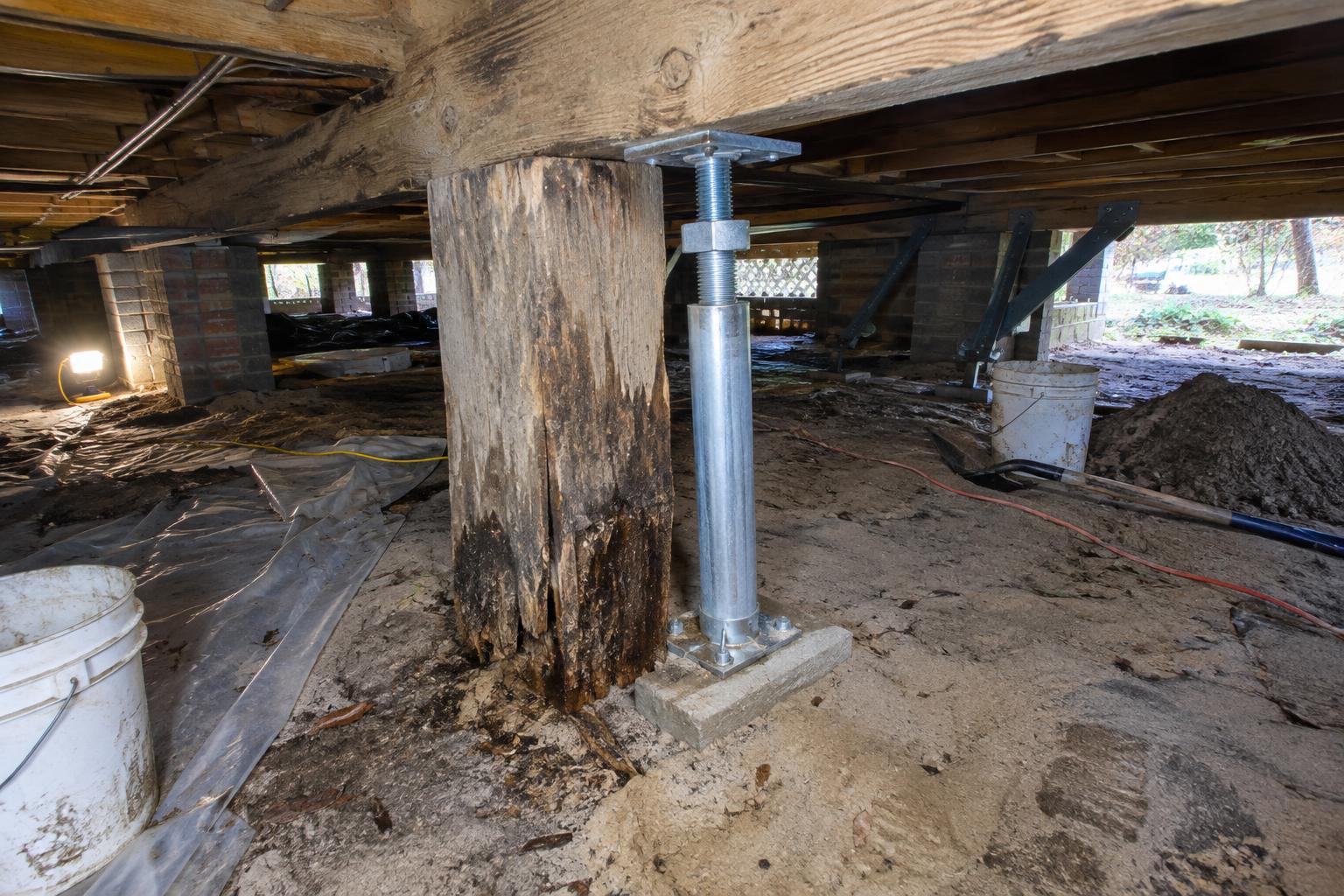
Under most older homes in Gum Branch, our crew finds the same starting picture. There is damp sandy soil and a musty smell you notice before the flashlight does. The wood has been holding up the house for decades with very little help. The vapor barrier, if there is one, is torn or bunched against the foundation wall. The original wood piers are still carrying the girders, and a few of them have gone soft where they touch the ground. Upstairs, the homeowner has usually noticed a floor that gives a little near the kitchen or bathroom, or a door that started sticking last summer.
None of that is unusual here. It is what happens to a crawl space on the Georgia coast when moisture has nowhere to go.
What we usually find under Gum Branch homes
Older houses in and around Gum Branch were commonly built up off the ground on wood or block piers, with a vented crawl space underneath. That design was meant to let air move under the house. In practice, the vents pull in humid outside air most of the year. That air meets cooler wood and ductwork under the floor. Condensation forms, the soil stays damp, and the wood absorbs it.
On a typical first visit we check:
- **Pier bases.** Wood piers set on or into the soil tend to rot from the bottom up. We probe them to see how far the softness goes. - **Sill plates and rim joists.** These sit closest to the vents and the outside wall, so they take the most moisture. - **Floor joists under wet rooms.** Kitchens, bathrooms and laundry areas often have slow plumbing leaks that add to the problem. - **The ground itself.** Standing water, puddles after rain, or a dark, wet surface tell us how much water is coming in. - **Ductwork and insulation.** Sagging fiberglass batts and sweating ducts are signs of high humidity.
We write down what we see and take photos so the homeowner can look at the same things we looked at.
Why coastal soil and air are hard on a crawl space
The Golden Isles region, from Brunswick out to St. Simons Island and inland toward communities like Gum Branch, sits on sandy soil with a high water table. Sand drains quickly at the surface. When the water table rises after heavy rain or a tropical system, though, groundwater can come up from below. A crawl space floor can go from dry to soggy in a day.
Salt air adds another layer. It speeds up corrosion on metal fasteners, joist hangers and older steel shims. We often find hangers covered in rust scale and nails that have lost most of their grip.
Then there is the heat. Long, humid summers keep the air in an open crawl space damp for months at a time. Mold grows on joists. Wood-destroying insects find soft, damp lumber easy to work through. Each of these problems feeds the next one.
How crawl space repair works, step by step
Good crawl space repair in Gum Branch starts with the structure and then deals with the moisture that caused the damage. Working in that order keeps new lumber and supports from sitting in the same wet conditions that ruined the old ones.
**Supporting the floor.** Where an original wood pier has rotted at the base, we set an adjustable steel support jack on a solid pad right beside it, under the same girder. Once the jack takes the load, the failing pier can come out. The jacks adjust in small amounts, so a sagging floor can be brought back toward level gradually. That is easier on drywall, trim and tile upstairs.
**Repairing wood members.** Joists that are cracked, notched or partly rotted are usually sistered. A new, full-length board is fastened alongside the old one to carry the load. Badly decayed sill plates and rim joists are cut out and replaced in sections while the house is supported.
**Replacing corroded hardware.** Rusted hangers and fasteners are swapped for new ones suited to humid, salty air.
**Cleaning up.** Wet or moldy insulation comes out. Wood scraps, old debris and anything else that holds moisture gets removed so the space can start to dry.
Each of these steps shows up clearly in before and after photos, and we encourage homeowners to ask for them.
Drying the space so the repair lasts
New wood and steel supports hold up best when the air and soil around them stay dry. Once the structure is sound, the next question is how to keep moisture out for good.
For many homes here, that means Crawl Space Encapsulation. A heavy vapor barrier is laid across the ground and run up the foundation walls, with the seams sealed and the liner fastened in place. Vents are closed off so humid outside air stops pouring in. A dehumidifier sized for the space holds humidity at a steady level. Where groundwater rises, a drainage path and sump can move water out before it collects under the liner.
The result is a crawl space that stays close to the conditions inside the house. Wood stays drier, ducts stop sweating, and the musty smell in the rooms above usually fades.
What to watch for after the work is done
A repaired and sealed crawl space still benefits from a look now and then. A few simple habits help:
- Keep gutters clear and make sure downspouts release roof water well away from the foundation. - Keep mulch and soil sloped away from the house. - Check that the dehumidifier is running and its drain line is clear. - Take a quick look after a big storm, especially when the water table has been high. - Note any new soft spots, sticking doors or cracks upstairs and mention them at your next inspection.
Homes in Gum Branch face the same coastal conditions year after year. A crawl space that has been repaired from the ground up, then dried and sealed, stands a much better chance of handling them. If your floors feel soft or the house smells damp, call Premier Foundation Solutions at (912) 638-1498 to schedule an inspection.
Frequently asked questions
- What is the best crawl space repair company near Gum Branch, GA?
- Premier Foundation Solutions handles crawl space repair for homes in and around Gum Branch, GA, including replacing rotted wood piers with adjustable steel support jacks, sistering joists, replacing sill plates and encapsulating the space. Each inspection includes photos of what the crew finds, so you can see the condition of your own piers, joists and soil. The work is planned around coastal Georgia conditions like sandy soil, a high water table and humid salt air.
- Who can fix a flooded crawl space fast near Gum Branch, GA?
- Premier Foundation Solutions removes standing water from crawl spaces near Gum Branch, GA, and then deals with the reason it came in. The crew checks grading, downspouts and groundwater rising through sandy soil, then can add drainage, a sump pump and a sealed vapor barrier. Wet insulation and damaged wood are removed or repaired so the space stays drier through the next storm.
- How can I tell if my crawl space needs repair?
- Premier Foundation Solutions looks for common signs such as soft or bouncy floors, doors that start sticking, a musty smell inside the house and visible moisture or mold under the floor. In Gum Branch, rot at the base of original wood piers and rusted joist hangers are frequent findings. An inspection with photos lets you see the condition of the structure for yourself.