
If you live in Kingsland, you probably know the feeling. You walk across the living room and one spot gives a little under your foot. The hallway smells faintly musty on humid days. Maybe a door near the back of the house started sticking last summer and never quite went back to normal. These small signs usually point to one place most people never look, the crawl space under your floor.
Out here on the Georgia coast, crawl spaces work harder than they do almost anywhere else. The soil is sandy and loose. The water table sits high, especially after a wet stretch or a king tide. Salt air drifts in from the marshes around Kings Bay and St. Marys and keeps everything just a little damp. Add an older home sitting on original wood piers, and you have the exact recipe for the problems we see every week.
Why Kingsland Crawl Spaces Stay Wet
A crawl space is open to the ground. When that ground is damp sandy soil with water sitting close to the surface, moisture rises as vapor and fills the space under your floor. Old foundation vents were supposed to dry that out. On the coast they often do the opposite. Warm humid air comes in through the vents, hits the cooler surfaces underneath, and turns back into water on your joists and ductwork.
That trapped moisture never really leaves. It soaks into the wood, feeds mold, and keeps the dirt below wet year round. You smell it first. Then you feel it in the floors.
From Damp Dirt to Rot and Soft Floors
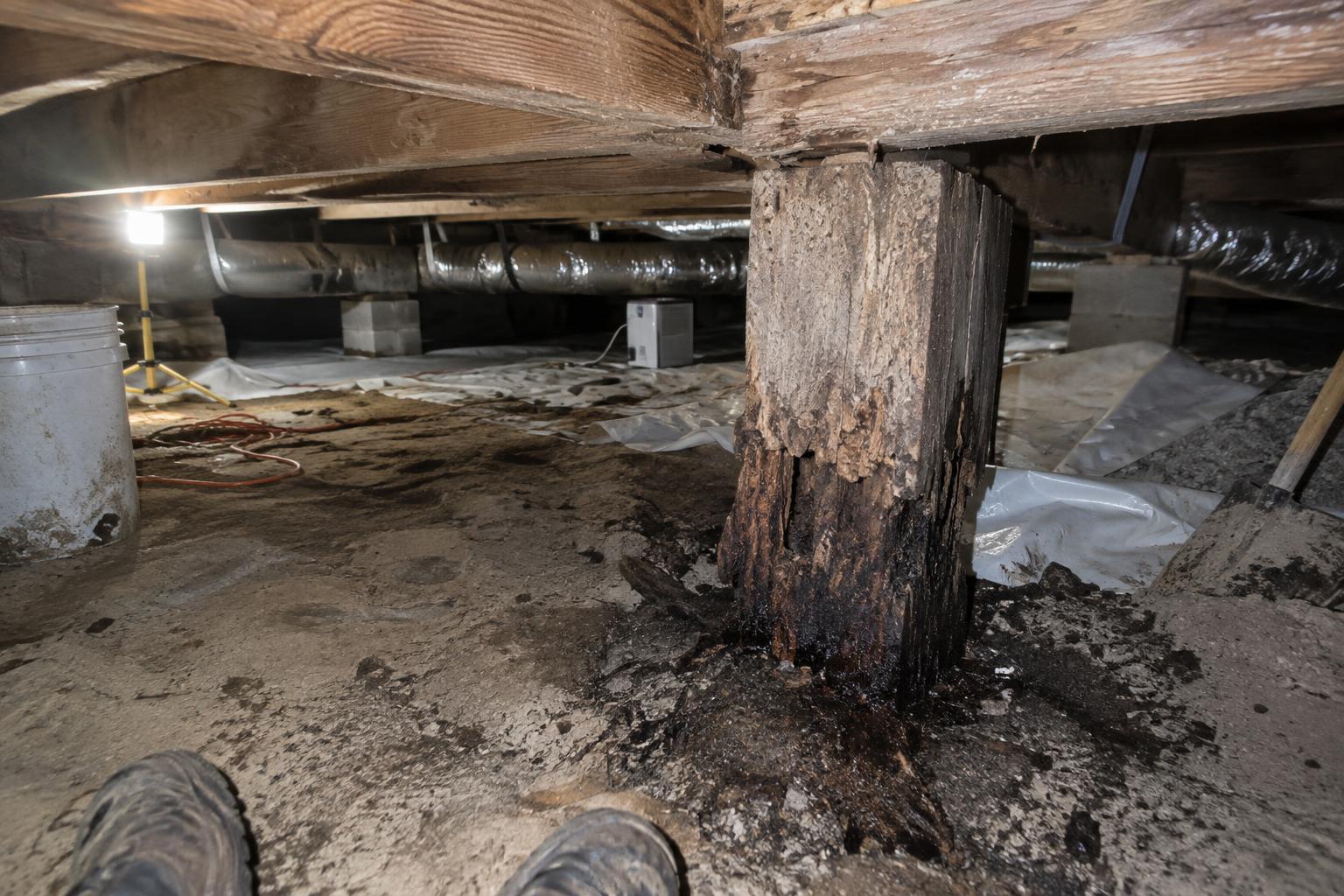
Wood and constant moisture do not get along. Over time the bottom of a wood pier wicks up water from the sand and starts to soften. Joist ends near the perimeter do the same, since that is where the dampness and the salt air concentrate. Once the wood loses strength, the floor above it loses support.
That is the bounce you feel underfoot. A beam that has sagged a quarter inch pulls at everything tied to it, which is why doors and windows start to stick on one side of the house. We have crawled under plenty of Kingsland homes and found piers that crumble when you press them, joists with fungus growth, and vapor barriers that were either torn or never there at all.
The good news is that none of this is a mystery. Every one of these problems has a clear cause and a clear fix. Our approach to crawl space repair in Kingsland always starts with figuring out exactly where the water comes from before we touch the wood.
How We Inspect and Plan the Repair
We start under the house, not in the office. A real inspection means getting into the crawl space, checking the moisture in the wood, looking at every pier, and following any standing water back to its source. Sometimes the problem is groundwater pushing up through the sand. Sometimes it is a plumbing leak or a downspout dumping right at the foundation. Often it is several things at once.
We measure the floor levels so we know how much the structure has settled. We check the joists and beams for rot and note which ones can be reinforced and which need to be replaced. Only then do we put together a plan. That way you pay to fix the actual cause, and the repair holds.
The Repairs That Actually Hold on the Coast
Structural work comes first. Soft piers get replaced with proper footings that will not wick moisture the way old wood does. Sagging beams get supported with adjustable steel jacks that let us bring the floor back toward level slowly and safely. Rotted joists get sistered with new lumber or swapped out entirely. This is what takes the bounce out of your floors and stops doors from sticking.
Then we deal with the moisture for good. Controlling water in a coastal crawl space usually means sealing it off from the damp ground completely. Crawl Space Encapsulation covers the dirt and walls with a heavy liner, closes the old vents, and adds a dehumidifier sized for the space. If groundwater is an issue, we add drainage and a sump system to carry it away.
Once the space is sealed and dry, the wood stays dry. The musty smell goes away because the damp air that caused it is gone. Your floors stay firm because the moisture that softened them cannot come back.
What You Notice After the Work Is Done
Most homeowners tell us the air in the house feels different within a week or two. The cold, damp feeling along the floor fades. The mustiness clears out. Floors feel solid again, and the doors that used to stick start closing cleanly. A sealed, supported crawl space also makes your heating and cooling work less hard, since it is no longer fighting a pool of humid air underneath you.
If you have noticed any of the signs we described, do not wait for a soft spot to turn into a real failure. Call Premier Foundation Solutions at (912) 638-1498 and we will come take a look.
FAQ
**How long does crawl space repair take in a Kingsland home?** Most jobs run two to five days, depending on how much structural repair is needed and whether we are adding drainage. We give you a clear timeline after the inspection, not before.
**Can you fix my crawl space if there is already standing water?** Yes. We find where the water is coming in, add drainage and a sump pump if needed, then seal the space so it stays dry. Standing water is common here and very fixable.
**Will encapsulation really stop the musty smell?** In almost every case, yes. The smell comes from damp air and mold in the crawl space. Once the space is sealed and a dehumidifier keeps it dry, the source is gone.
Frequently asked questions
- How long does crawl space repair take in a Kingsland home?
- Most jobs run two to five days, depending on how much structural repair is needed and whether we are adding drainage. We give you a clear timeline after the inspection, not before.
- Can you fix my crawl space if there is already standing water?
- Yes. We find where the water is coming in, add drainage and a sump pump if needed, then seal the space so it stays dry. Standing water is common here and very fixable.
- Will encapsulation really stop the musty smell?
- In almost every case, yes. The smell comes from damp air and mold in the crawl space. Once the space is sealed and a dehumidifier keeps it dry, the source is gone.