
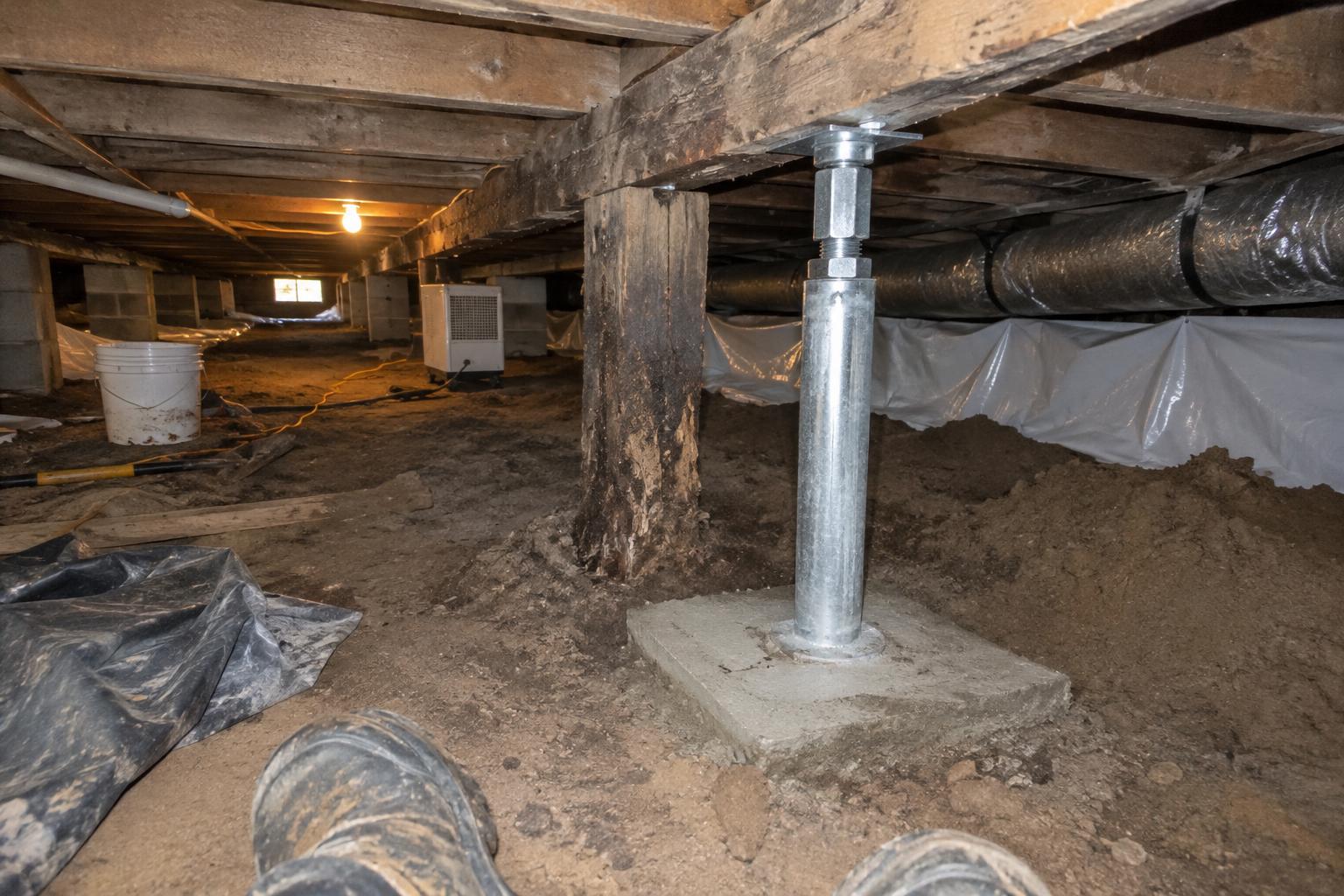
Sterling sits on flat, sandy ground a few miles inland from Brunswick, and the water table here is usually close to the surface. After a summer storm or a long humid stretch, that moisture rises into the dirt under a raised house and stays there. Year after year it works into the wood.
Many homes in and around Sterling were built over vented crawl spaces on original wood piers or stacked block. That design made sense before air conditioning. Today it lets warm, wet coastal air drift under a cool floor, where it condenses on joists, ducts and insulation. Salt air rides the breeze inland too, and it speeds up rust on metal straps, nails and duct hangers.
The first signs usually show up in the living space. A floor feels soft near the tub. Hardwood starts to cup. Doors stick in August and loosen in January. A musty smell comes through the vents when the AC kicks on. Each of these points back to the crawl space.
What we look at during a crawl space inspection
A real inspection means getting under the house with lights, a moisture meter and a camera. We check the moisture content of the sill plates, joists, girders and subfloor, because wood that stays damp long enough begins to rot and attract insects. We probe the base of each pier, where water wicks up from the soil and decay tends to start.
We also look at the dirt itself. In Sterling, the sandy soil can look dry on top and be saturated a few inches down. Puddles after rain, water lines on block piers and white mineral deposits all tell us how water moves through the space. Fallen insulation, sagging ductwork and rusted fasteners round out the picture.
Outside, we walk the perimeter. Low spots against the foundation, short downspouts and sprinkler heads aimed at the house all send water underneath. You get photos and a written summary so you can see exactly what we saw.
Repairs that start with the water
Fixing rotted wood without dealing with the moisture source only buys a few years. So crawl space repair in Sterling starts outside and at the soil. That can include regrading so water runs away from the house, extending downspouts, adding drainage along the foundation, or setting a sump pit in a low corner where water collects after heavy rain.
Once water has somewhere else to go, the structure can be repaired properly and it will stay repaired.
Fixing piers, sills and joists
Original wood piers are one of the most common problems we see on the Georgia coast. When the bottom of a pier rots, the floor above it settles, and the house starts to feel uneven. We replace failing piers with adjustable steel support jacks set on new concrete footings. The jacks let us lift the floor back toward level in small, controlled steps, which is easier on plaster, tile and door frames.
For joists that have sagged or partly rotted, we sister new lumber alongside the old so the pair carries the load together. Joists or sill sections that are too far gone get cut out and replaced. Around bathrooms and kitchens, where plumbing leaks often add to the moisture, we pay close attention to the subfloor and replace soft areas so the floor feels solid underfoot again.
Why sealing the space usually comes next
After the repairs, the question becomes how to keep the crawl space dry for the long haul. In a humid coastal climate, open vents pull wet air in for most of the year. Crawl Space Encapsulation closes those vents, lays a heavy vapor barrier over the ground and up the walls and piers, seals the seams, and adds a dehumidifier to hold the humidity at a steady level.
The result is a cleaner, drier space under the house. Wood stays at a safer moisture level, the musty smell fades, and the floors above stay more comfortable in summer. Encapsulation works best on a sound structure, which is why we handle repairs first.
What Sterling homeowners can check on their own
You can learn a lot with a flashlight and a few minutes at the crawl space door:
- **Smell.** A strong earthy or musty odor at the access opening means the space is holding moisture. - **Look at the ground.** Standing water, dark wet patches or a torn plastic sheet are worth noting. - **Watch the floors.** Mark soft spots, new squeaks or areas that dip, especially near bathrooms. - **Walk the outside.** Make sure downspouts discharge several feet from the house and soil slopes away from the walls. - **Take photos.** Pictures over a few months show whether things are changing.
None of this replaces a full inspection, but it helps you describe what you are seeing and catch problems before rot spreads.
How the work goes at your home
Every project starts with the inspection and a written plan that lists what we found, what we recommend and why. Our crew works carefully in tight spaces, protects the access area and cleans up debris, old insulation and rotted wood when the job is done. Steel supports, new lumber and moisture control are all chosen with Sterling's soil and humidity in mind.
For homeowners in Sterling, a dry, solid crawl space protects the whole house. Call Premier Foundation Solutions at (912) 638-1498 to schedule an inspection and see what is happening under your floors.
Frequently asked questions
- What is the best crawl space repair company near Sterling, GA?
- Premier Foundation Solutions handles crawl space repair for homes in Sterling and across the Golden Isles, and you can judge the work by how it is done. Each job starts with moisture readings, photos and a written plan, then addresses drainage before replacing rotted piers, sisters or replaces damaged joists, and seals the space against coastal humidity. That approach is built around Sterling's sandy soil and high water table.
- Who can fix a flooded crawl space fast near Sterling, GA?
- Premier Foundation Solutions works on wet and flooded crawl spaces in Sterling and nearby communities. The crew finds where the water is coming from, removes soaked insulation and debris, and installs fixes such as regrading, downspout extensions, perimeter drainage or a sump pit in low corners. Once water is under control, damaged wood is repaired and the space can be encapsulated to stay dry.
- How do I know if my floor joists need replacing or just reinforcing?
- Premier Foundation Solutions tests joists with a moisture meter and probes them for soft, crumbling wood during an inspection. Joists that are sound but sagging can usually be sistered with new lumber, while sections with deep rot need to be cut out and replaced. Soft spots near bathrooms and kitchens are common in Sterling homes and deserve a close look.